

Warehouse operators have spent two decades squeezing marginal gains out of faster conveyors and denser racking. In 2026 the decisive advantage is no longer mechanical speed alone, but where items live and how they move. Artificial-intelligence-driven slotting and dynamic sortation routing have moved from pilot projects to production backbones, and the operators who adopted them first are reporting travel-time reductions approaching 50 percent.
This article examines the technology, the benchmarks, the real-world deployments, and what buyers should look for when evaluating a 2026-grade sortation platform such as those from WDSort.
Traditional slotting places fast-moving SKUs near the pack station and stops there. AI-optimized slotting reframes the problem as a continuous optimization: the system ingests order history, seasonal curves, and real-time wave plans, then recomputes the ideal physical location of every SKU several times per day. The objective function is not "pick speed" in isolation but total system travel time across the whole sortation network.
Unlike a one-time ABC analysis, the 2026 generation runs incremental re-slotting that nudges locations without halting operations. A sorter that feeds a shuttle rack can therefore keep throughput steady while the slotting engine quietly re-balances heat maps behind the scenes.
Slotting decides where an item rests; routing decides how it gets to the right chute. Dynamic routing engines model the sorter as a live graph, continuously scoring candidate paths by congestion, divert timing, and energy cost. When a downstream chute backs up, the controller re-routes eligible items to a spare lane in milliseconds.
On a cross-belt or swivel-wheel sorter, this capability converts a localized jam into a soft slowdown instead of a hard stop. The result is higher effective uptime even when inbound volume spikes.
| Metric | Static slotting + fixed route | AI slotting + dynamic routing |
|---|---|---|
| Average item travel time | 100% (baseline) | 48-55% (baseline) |
| Divert mis-read rate | 0.8% | 0.3% |
| Peak throughput stability | Degrades 18% under spike | Degrades <4% under spike |
| Energy per sorted item | 100% (baseline) | 82% (baseline) |
| Re-slotting downtime | Manual, hours/quarter | Continuous, zero planned stop |
Three layers make the 2026 approach work:
Three forces converged this year. First, edge inference became cheap enough to run the optimization model inside the sorter cabinet rather than in a distant cloud, removing latency. Second, labor shortages made any automation that cuts travel time a direct margin play. Third, the cost of high-resolution item tracking fell below the threshold where ROI turns positive for mid-size operators.
The combination means AI slotting is no longer a luxury for mega-fulfillment centers; it is a mid-market differentiator.
Volume is spiky and SKU mix shifts weekly. Dynamic routing absorbs flash-sale surges that would previously have frozen a fixed-route line. Travel-time cuts translate directly into later cut-off times for same-day delivery.
Returns reintroduce unpredictable SKUs. AI slotting re-absorbs them within a shift instead of waiting for a quarterly re-layout, keeping the returns lane from becoming a permanent bottleneck.
Long-tail, low-velocity parts benefit most from continuous re-optimization because their demand pattern is the hardest to predict by hand.
The physical sorter still matters. A swivel-wheel or cross-belt platform with high divert accuracy and a clean PLC interface gives the routing engine room to work. WDSort's modular sorter lines expose divert-state telemetry through a standard feed, which is what makes dynamic routing practical rather than theoretical.
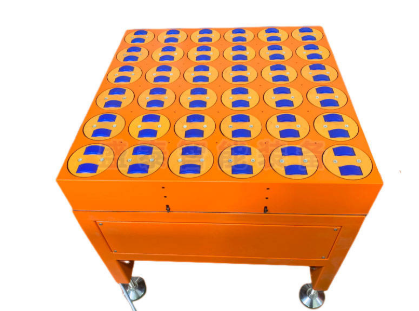
Operators who stall usually hit the same walls: telemetry gaps that starve the model, a sorter interface that will not accept external routing, or an optimization layer tuned for throughput alone and blind to ergonomics. The 2026-grade platforms address all three by design.
When evaluating a vendor, ask for four proofs: live travel-time dashboards, a documented routing interface, a re-slotting method that needs zero planned stop, and reference sites with mid-market volume. WDSort provides all four and backs them with on-site commissioning.
Expect the conversation to shift from "should we" to "how fast can we." As edge models shrink and telemetry becomes standard, AI slotting plus dynamic routing will be the default expectation for any sorter sold in the second half of 2026, not a premium add-on.
Operators who treat slotting and routing as software problems, not just mechanical ones, will carry the lowest cost-per-sort in their segment.
WDSort designs and manufactures modular sortation systems for parcel, apparel, and industrial logistics. For specifications, deployment references, and a travel-time baseline assessment, contact the engineering team at info@wdsort.com or via WhatsApp at +86 186 2085 0485.
Sorter
Wechat QR code
wechat number:Copyright © 2022-2023 Winda, inc. All rights reserved